Independence
The steamship Independence played a significant role in California’s madcap gold-fueled rush onto the world stage and her February 16, 1853, wreck made headlines from San Francisco to London.
Operated by Cornelius Vanderbilt’s Independent Line and under the command of Capt. P.L. Sampson, she was bound for San Francisco from San Juan del Sur, Nicaragua, via Acapulco, Mexico, when she struck a reef off the southern tip of Isla Margarita, Baja California.
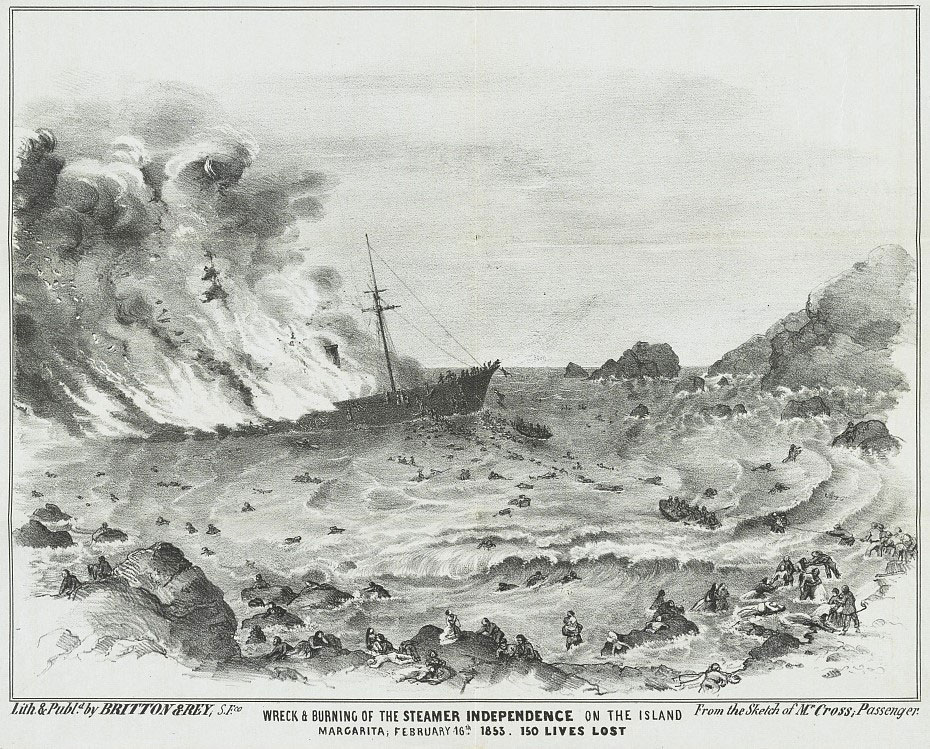
She quickly caught fire and sank about 300 yards from shore.
In an interview published later in several California newspapers including the Daily Alta California and the Sacramento Union, Capt. Sampson later stated that, “Every effort was made to get the fire under, but to no avail. The flames were now coming up from the hatchways, fire-room, engine-room, ventilators, and around the smokestack; everything was consternation and dismay; the people seemed completely bewildered and were jumping overboard by dozens.
“The scene was perfectly horrible and indescribable ─ men, women, and children screeching, crying and drowning. I ordered the spars, hatches, tables and everything that would float, to be thrown overboard, which was done, and they were immediately covered with people.
“About an hour after the ship struck the beach she was in a perfect sheet of flame, and there was no one on board of her except one of the coal passers, named Beaumont, and myself. The smokestack had fallen, and the promenade deck forward had fallen in; the flames were coming out of the side lights, and it was impossible to stay on board any longer.
“A boat came off from the shore with two of the deck hands in her. Beaumont, who was near the fore rigging, jumped into her, and I jumped overboard, swam to her, and commenced picking up those who were afloat.
“After picking up three boat loads, Thomas Herren, steward, succeeded in launching another boat, and saving some of the people. When all that were alive had been picked up, and some of the baggage, I landed and had the spars which had drifted ashore hauled up into a ravine, and with one sail that had washed ashore, made a tent large enough to shelter the women and children.”
There were 430 passengers and crewmen on board with the estimates of the number of people lost in the wreck ranging from 130 to 175. The survivors were stranded for three days before Capt. Sampson was able to contact several whaling ships anchored in Magdalena Bay that joined forces and came to the survivor’s rescue.
According to Capt. Sampson, “Too much cannot be said in favor of the humane conduct and kind treatment received from Capt. J. Fisher and officers of the ship Omega; Capt. Wheldon of the ship James Maury; Capt. Jeffries of the ship Meteor; Capt. Lane, of the bark Clemente, and Capt. Gordon, of the schooner A. Emery. who promptly came to our relief as soon as they heard of our situation; and rendered us all the assistance and made us as comfortable as possible.“
The hero of the day was one of the ships engineers, later credited with saving the lives of more than 90 passengers when the Independence went down.
Giving up the seafaring life, the engineer later joined the predecessor of the San Francisco Fire Department and would, in years later, become a close friend and poker partner of Samuel Clemens, a young newspaper reporter later known as Mark Twain, who would later immortalize his old friend in his very first novel.
The former Independence engineer’s name was Tom Sawyer.