Miroslav
The age of the clipper ship in the years preceding the American Civil War saw naval architecture in the United States reach a zenith that has never been surpassed.
Built for both speed and utility, scores of sleek clippers bearing such names as Sweepstakes, Red Jacket, Challenge, and Flying Fish linked both American coasts via Cape Horn with ports throughout Asia and Europe. One of these greyhounds of the sea was the Young America.
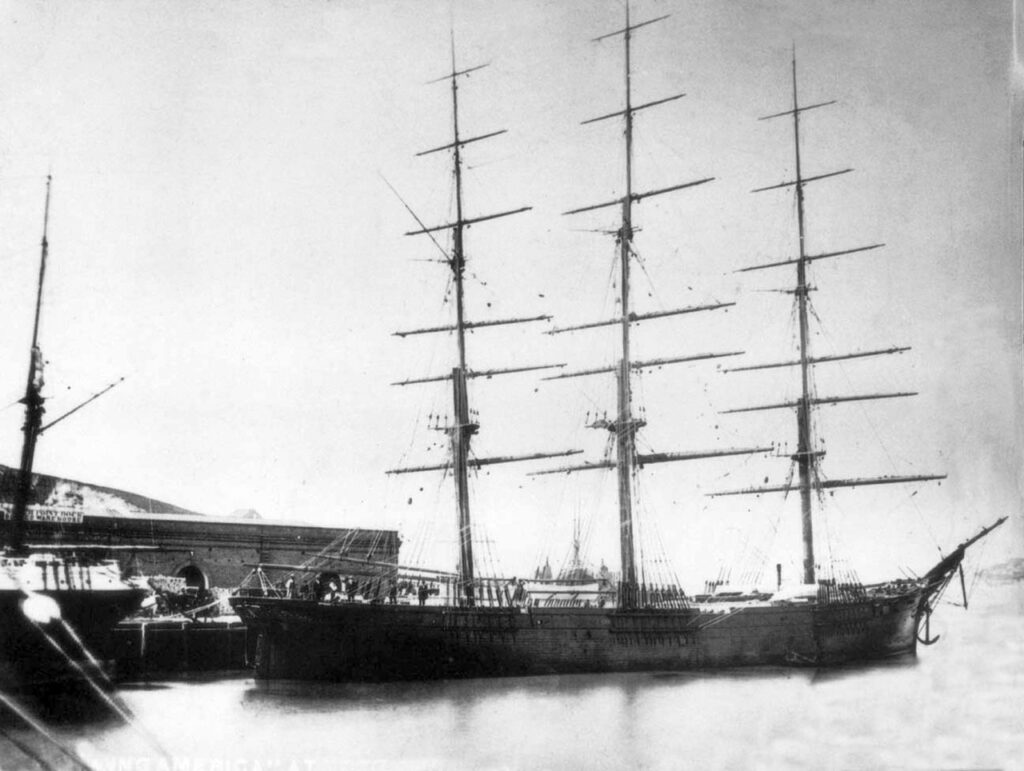
Built at a cost of $140,000, she was built at William Webb’s New York shipyard. Launched in April 1853. She was full-rigged on three masts, measured 239 feet in length, displaced 1,380 tons, and said one maritime historian…”for beautiful lines and general handsome appearance, she was not exceeded by anything afloat.”
The Young America was always a prime favorite with shippers, commanding the highest freight rates. On her maiden voyage from New York to San Francisco, her cargo manifest totaled $86,400 in value, equal to $2.7 million today.
A near-fatal brush with catastrophe came in December 1868 when she was caught in a severe gale off the eastern coast of South America while outbound from New York for the Golden Gate, laden with a full cargo of railroad iron.
Thrown on her beam ends, she became unmanageable and suffered heavy damage losing her fore royal mast, main top gallant mast and half of her mizzen mast.
Despite the danger, skillful stowage of the cargo, hours at the pumps by both crew and passengers, and the calm leadership of her master prevented disaster and the Young America arrived in San Francisco under a jury rig only 117 days out from New York.
On February 27, 1873, the Young America and the British clipper La Escocesa, each loaded with a full cargo of wheat, left San Francisco in a race to see which ship would reach the Port of Liverpool first.
Excitement ran high among the San Francisco shipping community with the confident captain of the English ship wagering several hundred dollars that he would reach Liverpool first. Some sources say that as much as $20,000 was bet on the race in San Francisco with an equal amount wagered in England.
The race was run with the Young America winning the challenge, reaching Liverpool in a respectable 106 days.
Over the next fifteen years, the Young America plied on. She departed New York on September 7, 1882, to round Cape Horn bound for Portland, Oregon, where she arrived after a voyage of one hundred and fifty one days.
Loading a partial cargo of wheat, the ship sailed south for San Francisco entering the Golden Gate on June 2, 1883.
She soon departed San Francisco, bound for New York on what was to be her last voyage under the American flag,
Soon after her arrival there her owner, San Francisco businessman John Rosenfeld, sold the tired Young America to an Austrian shipping syndicate for $13,500.
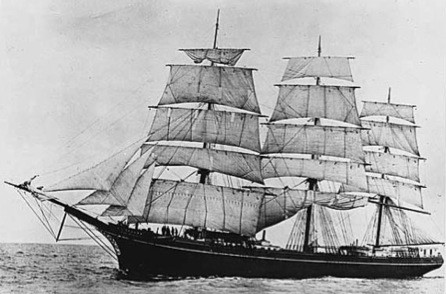
Renamed Miroslav and under the command of Captain R. Vlassich, she sailed in the transatlantic trades for two more years until February 17, 1886, when she took on a cargo of 9,700 barrels of crude oil in Philadelphia and cleared the Delaware breakwater, bound for the Adriatic port of Fiume, now the Croatian port of Rijeka.
Three months passed and on May 28, some 90 days after the Miroslav had sailed, the Philadelphia Inquirer wrote that the word along the Delaware River docks was that the Miroslav had probably foundered.
The passage, the paper wrote, “was usually accomplished in sixty days and that soon after the Miroslav sailed severe hurricanes swept the North Atlantic, sending several ships to the bottom.“
A few weeks later, the Lutine Bell at the Lloyd’s of London office was rung officially confirming that the ship was lost.
The Miroslav…ex-Young America “of beautiful lines and general handsome appearance” and her crew of twenty men had vanished and were never seen again.