May Flint
By the beginning of the 20th century, San Francisco had firmly established itself as a center for world commerce with the golden gate serving as a revolving door for shipping from all over the world.
On the evening of September 8, 1900, San Francisco Bay was crowded with ships…freighters, coastal steamers, liners, sailing ships and schooners, scows, warships, tugs, and barges.
Brightly lit, virtually everything afloat was bedecked with flags and bunting as the finishing preparations were being made for the next day’s celebration of the 50th anniversary of California’s statehood.
A huge waterfront party was in the offing, but the stage was being unknowingly set for another type of maritime performance…a farce actually…as a party crasher was in the wings, ready to make what was to be a disastrous entrance.
That evening, a ship entered the bay, plowed into the bay under full sail, rapidly closing on the mass of ships without a pilot or a tugboat to guide her.
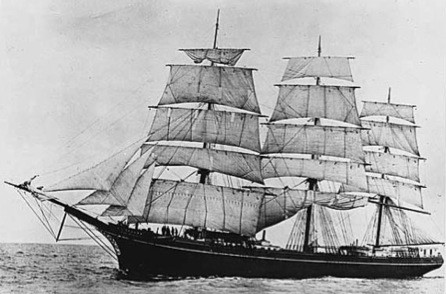
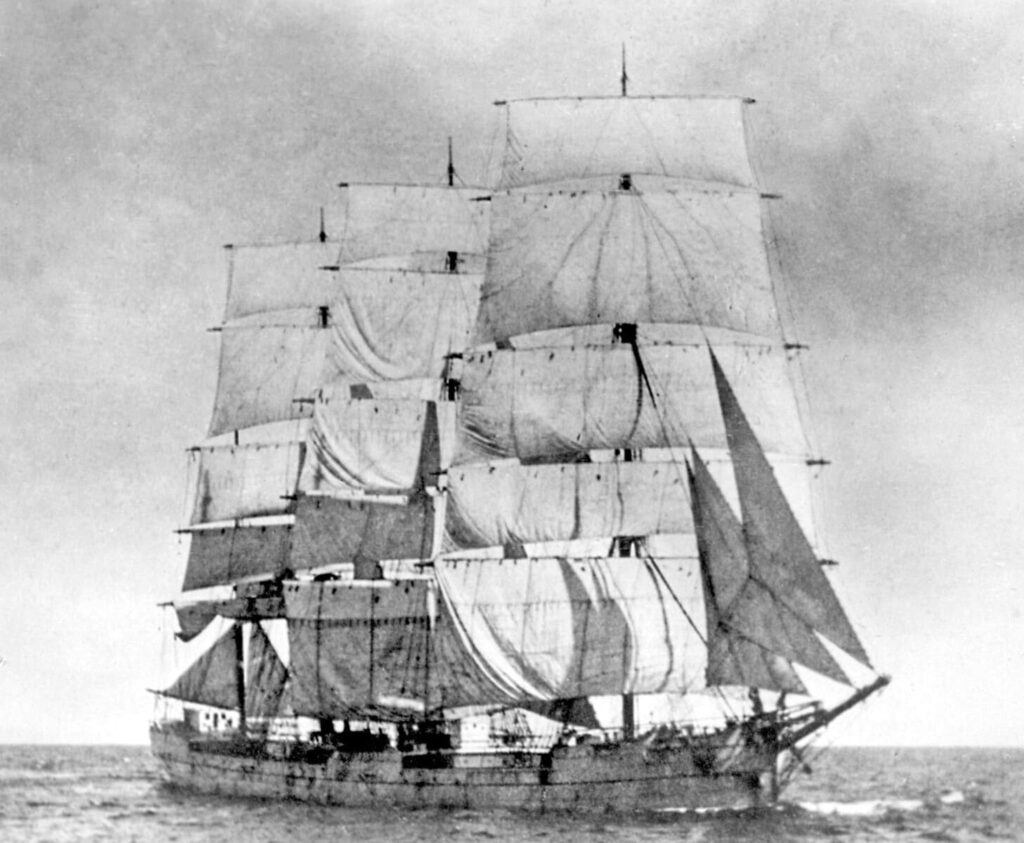
She was the four-masted bark May Flint, sailing under the command of Capt. A.M. Woodside and inbound from Seattle with five thousand tons of coal in her holds.
No sooner had the May Flint entered the Golden Gate, the wind unexpectedly died, the strong flood tide took control, and her lint rudder failed to respond to her master’s commands.
Out of control and in full view of thousands of spectators, she slammed into the ram bow of the brightly- lit veteran battleship, U.S.S. Iowa.
A jagged gash ripped in her side, the white-hulled May Flint drifted off the Iowa’s bow and caromed into…and seriously damaging… the Vidette, a 616-ton bark that was anchored close to the battleship’s starboard bow.
In the glare of half a dozen powerful searchlights, the May Flint turned turtle and sank to the bottom of San Francisco Bay, just twenty minutes after she entered the Golden Gate.
Valued at fifty thousand dollars, she was uninsured with her owner ─ the California Ship Company ─ filing a suit in court to limit their liability for the loss of the ship.
The wreck was sold for $4,450 and, at first, the May Flint’s new owner thought she could be raised, but divers found that her keel was broken, though they were able to salvage about 300 tons of coal from the wreck.
Lying in 90 feet of water, she was declared a menace to navigation and marked by a whistle buoy. Dynamite charges were eventually planted and the wreck of the May Flint was blown into pieces that were brought to the surface and sold for scrap.
Theories regarding the loss of the May Flint were rife along the San Francisco waterfront for months afterwards with some old salts claiming that the doomed bark might have remained afloat if the bulkheads removed during her steam-to-sail conversion to add a few hundred tons to her carrying capacity had been left in place.
There was, however, little speculation as to the role of Capt. Woodside in the loss of his ship.
Accused by the ship’s former owner of “attempting a grandstand play” by not taking a pilot aboard or hiring a tug to guide him to his berth, Woodside was found guilty of being “unskillful and negligent” and had his Master’s license revoked for a year.
At the time the third largest sailing vessel in the world, the 351-foot, 3,557-ton May Flint was originally built in 1880 as the steamship Persian Monarch for the transatlantic liner trades.
Over the years, she had developed a bad reputation as her earlier masters had been known as hard cases who mistreated their crews.
She was converted to sail in 1895 and was, according to noted British maritime historian Basil Lubbock, “hideous” and “the ugliest square rigger that ever sailed the seas.”