Hopestar
On November 2, 1948, the cargo steamship Hopestar left the Tyne in ballast for Philadelphia to load a cargo of grain for delivery to Alexandria, Egypt.
It would prove to be her last voyage.
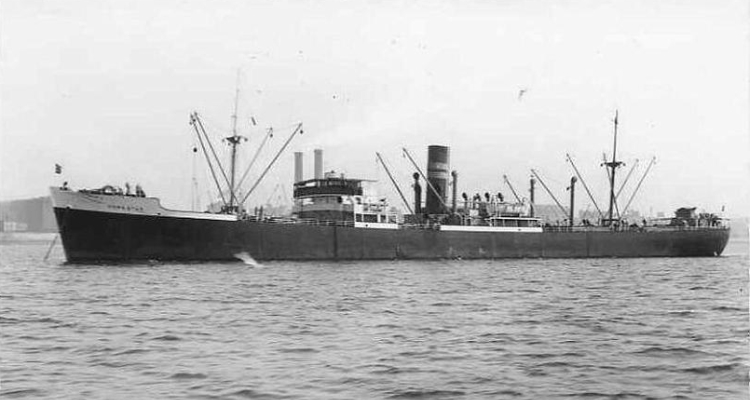
She was about 900 miles east of New York on November 14 when she radioed the company’s agents in Philadelphia stating that she had sustained damage to her deep tank owing to heavy weather.
The message from the Hopestar‘s Master, Capt. F. H. Dufton, said the Hopestar would make an emergency stop at Cape Henlopen, Delaware., and was expected to arrive there by 10:30 p m. on November 17.
That was the last message ever received from the ship and her crew of 40 men.
A massive search covering 10,000 square miles of ocean was conducted by the RAF, RCAF, U.S. Coast Guard, and U.S. Air Force aircraft. A number of ships braved heavy seas to add to the effort but none reported sighting her.
The search for the Hopestar was abandoned on November 27 and on December 31, the last day of the year, she was posted missing.
The 5,627-ton, turbine-engined ship was built in 1936 at the Tyneside shipyard of Swan, Hunter & Wigham Richardson. Reportedly, only a simple ceremony was held at her launching because of the death of King George VI.
The Hopestar sailed through the war unscathed and, in addition to her ordinary cargo-carrying duties, she served as a weather reporting ship, sending news to the air ministry in London on her trips across the Atlantic.
Capt. Dufton, 28, was one of the youngest ship captains in the British Merchant Navy and, just 10 months previous, had served as the Hopestar‘s First Mate.