Preussen
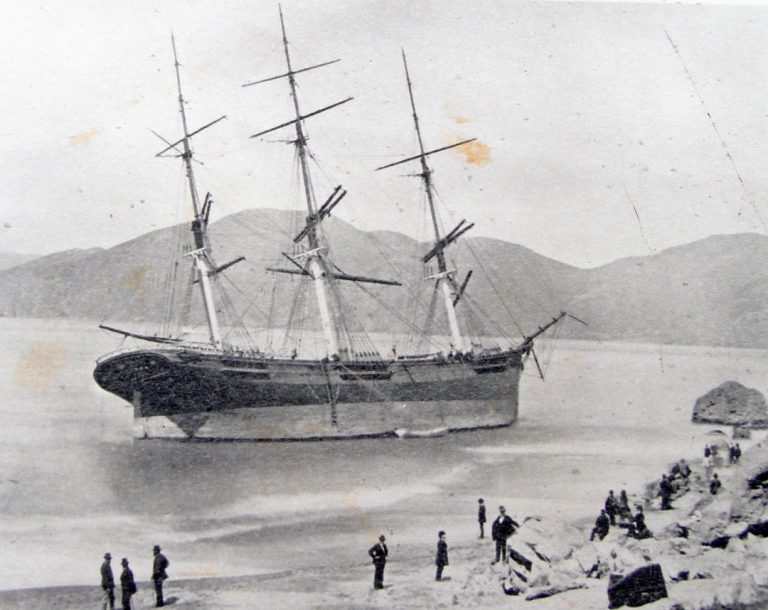
The 482-foot long, 5,081-ton, steel-hulled leviathan was designed by naval architect Georg Wilhelm Claussen and built at Geestemünde, Germany with five square-rigged masts that accommodated an unprecedented 72,360 square feet of sail.
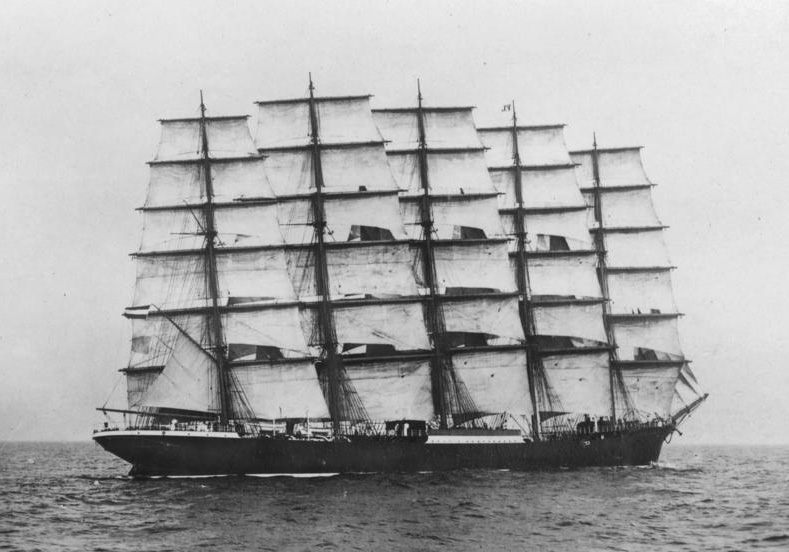
The Preussen, manned by a crew of 48 and equipped with wireless telegraphy, sailed as one of the fleet of Flying P ships operated by the Laeisz shipping company of Hamburg.
Just twenty-four days after work on her was finished, Preussen made her maiden voyage from Bremerhaven to the Chilean port of Iquique.
Built to carry upwards of 8,000 tons of cargo, she became famous for her was known for her speed…in fact, in one eleven-day period, she sailed 3,019 miles, an average speed of over 11 knots. In favorable weather conditions, the ship could reach a speed of 20 knots.
Built to sail in the lucrative pre-World War One nitrate trade between Europe and Chile via Cape Horn, and despite her impressive size and cargo capacity, the Preussen wasn’t as economically successful as her owners had hoped.
On the homeward voyage from Chile to Europe, her holds were relatively full of nitrate fertilizer, but finding 8,000 tons of South American-bound freight to fill her cavernous holds on the return trip was another matter.
In fact, of her fourteen round-trip voyages between Hamburg and Chile, the Preussen weighed anchor only twice with her holds full of cargo.
The Preussen was diverted from her usual business in April 1908 when she was chartered to the Standard Oil Company of New Jersey to haul a cargo of case oil from new York to Yokohama. She made that run in a record 112 days.
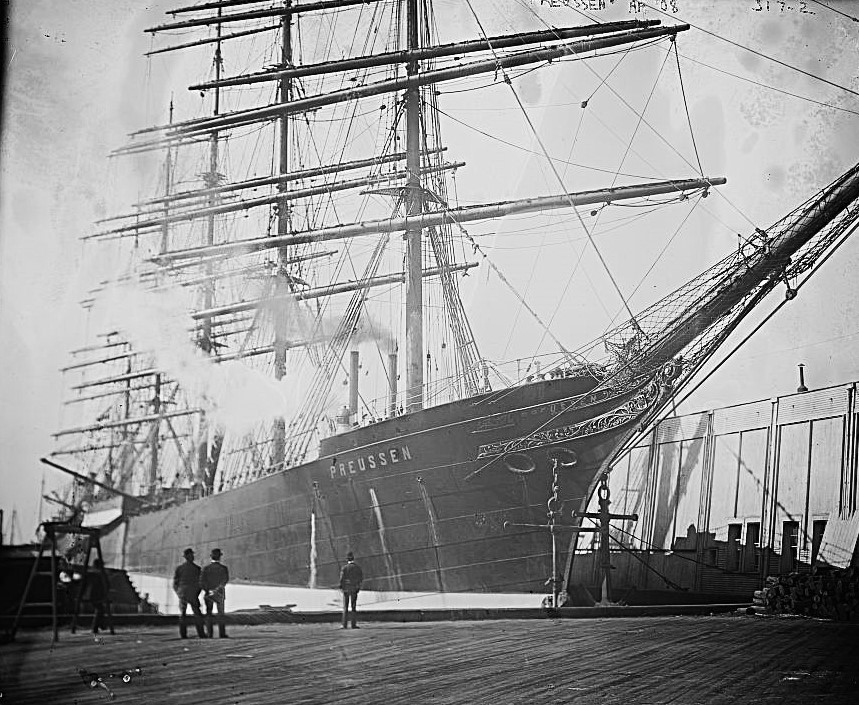
The ship made headlines in papers across the country during her week-long visit to New York, attracting more than 3,000 visitors to pier 3 in south Brooklyn who gawked in amazement at the massive ship.
Two years later, on October 31, 1910, the Preussen was outbound from Hamburg for Valparaiso via Cape Horn with a general cargo that included a shipment of pianos.
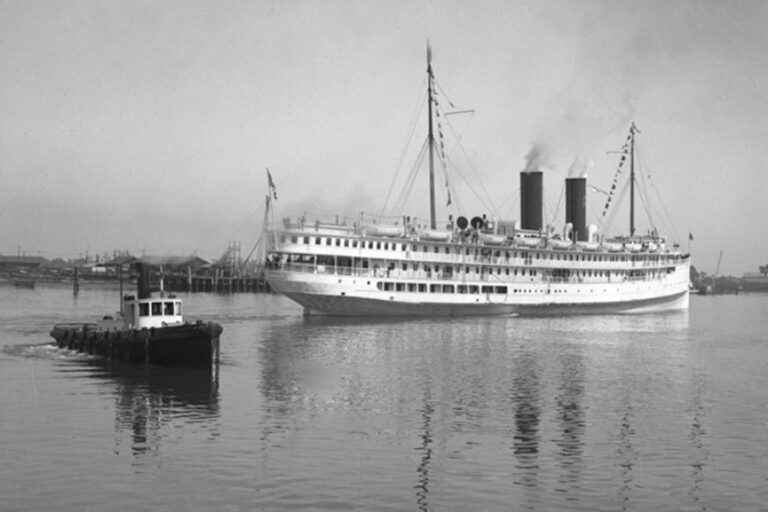
Soon after leaving port, she encountered increasingly dirty weather in the English Channel when, a little before midnight on Sunday, November 6, she collided with the small cross-channel steamer Brighton, which had underestimated the Preussen‘s speed, and tried to cross her bows.
Seriously damaged in the collision, the Preussen, her bow stove in, lost much of her forward rigging including her bowsprit and fore topgallant mast, damage that made it impossible to steer the ship to safety. The Brighton, though damaged herself, returned to the port of Newhaven to summon aid, while the Preussen anchored off Dungeness.
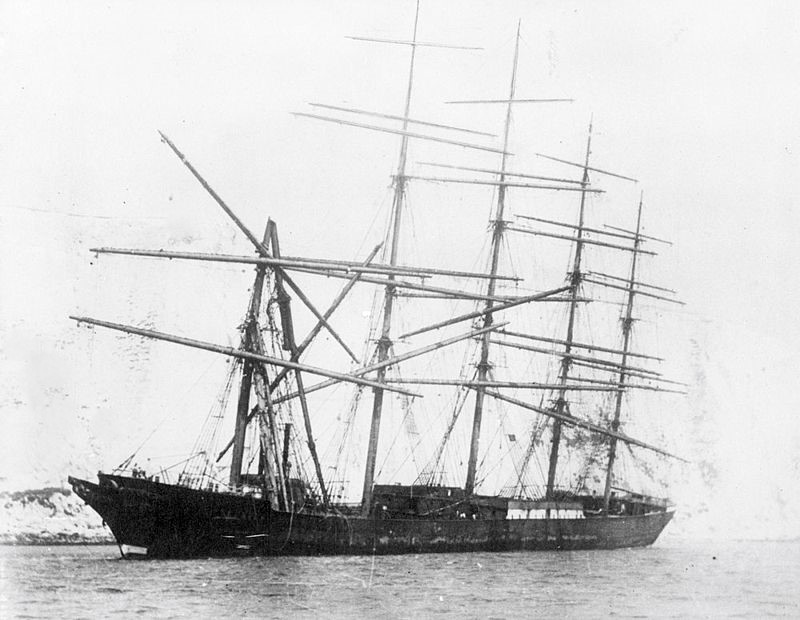
Two tugs were dispatched to assist the stricken giant, but her anchors chains broke and their attempt to tow her to the eastern entrance of Dover harbor failed when they were unable to hold the ship against a worsening gale.
The magnificent Preussen was doomed and nothing could save her. The wind and surging waves had their way, driving her onto the rocks at Crab Bay, where she sank, her keel broken, in three fathoms.
While crew, cargo and some equipment could be saved from the wrecked giant, she was abandoned and rendered unsalvageable.
To this day, at spring low tides, a few ribs of her hull can be seen, basically all that still remains of her.
The master of Brighton was found to be responsible for the accident. He lost his master’s license and later reportedly committed suicide by shooting himself in a London pub.
As for the Brighton herself…she was repaired and resumed her cross-channel duties. Serving during world war one as a troop ship, and later, as a hospital ship.
Years after the war, the Brighton was converted into a private yacht, renamed, and, in August 1933, went the way of the Preussen when she was wrecked in Killary Bay on the west coast of Ireland.