Golden Dolphin
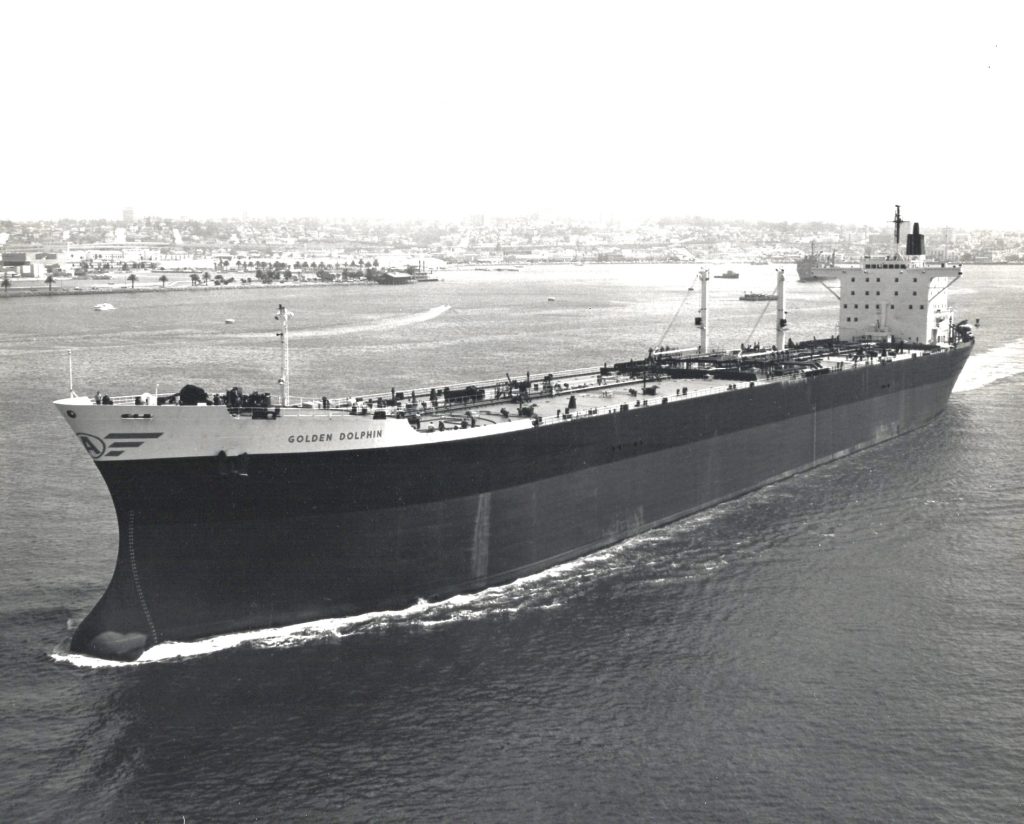
The tanker Golden Dolphin, sailing in ballast from New Orleans, Louisiana, to Dubai, United Arab Emirates, to pick cargo of crude oil, exploded and sank approximately 900 miles east of Bermuda on March 6, 1982.
Several members of the crew were using welding equipment and an oxygen-acetylene torch to replace a corroded section of the main deck steam piping, while, at the same time, five other crewmembers were cleaning one of the vessel’s cargo tanks.
About 4:00 p.m., the first of several explosions occurred in the Golden Dolphin‘s cargo tanks. An intense fire erupted and eventually engulfed the entire forward half of the vessel. On the following day, the vessel sank in the Atlantic Ocean about 900 nautical miles east of Bermuda.
Sixteen members of the ship’s crew of 25 were able to board on of the tanker’s lifeboats and were rescued by the Swedish freighter Norrland, which was about 30 miles from the scene when it received the stricken tanker’s distress call.
The nine missing men were in the tanker’s engine room at the time of the explosion and were never found.
After the tanker sank, the Norrland, later joined by a Yugoslavian vessel, the Nova, took the survivors to Gibraltar before continuing on to Sicily, its original destination.
The National Transportation Safety Board investigation team determined that “the probable cause of this accident was the ignition by a welding arc or oxygen-acetylene torch of combustible gases in the Golden Dolphin’s forward main deck steam piping and the propagation of the resulting flame through the steam piping into a cargo tank containing an explosive atmosphere.”
Contributing to the accident, it found, “was the failure of the master and the chief mate to ensure that the atmosphere within the cargo tanks, main deck steam piping, and cargo tank steam heating coils was gas free or inert.”
The U.S. Coast Guard convened a Board of Inquiry into the loss of the Golden Dolphin which concluded that a valve that would have prevented the ignition of the combustible gases was open at the time of the initial explosion.
Owned by Aeron Marine Shipping of New York, the 894-foot, U.S.-flagged tanker was built in 1974 at the National Steel & Shipbuilding Co. yard in San Diego, California. She was under contract to the U.S. Military Sealift Command and chartered to the U.S. Department of Energy when she was lost.